
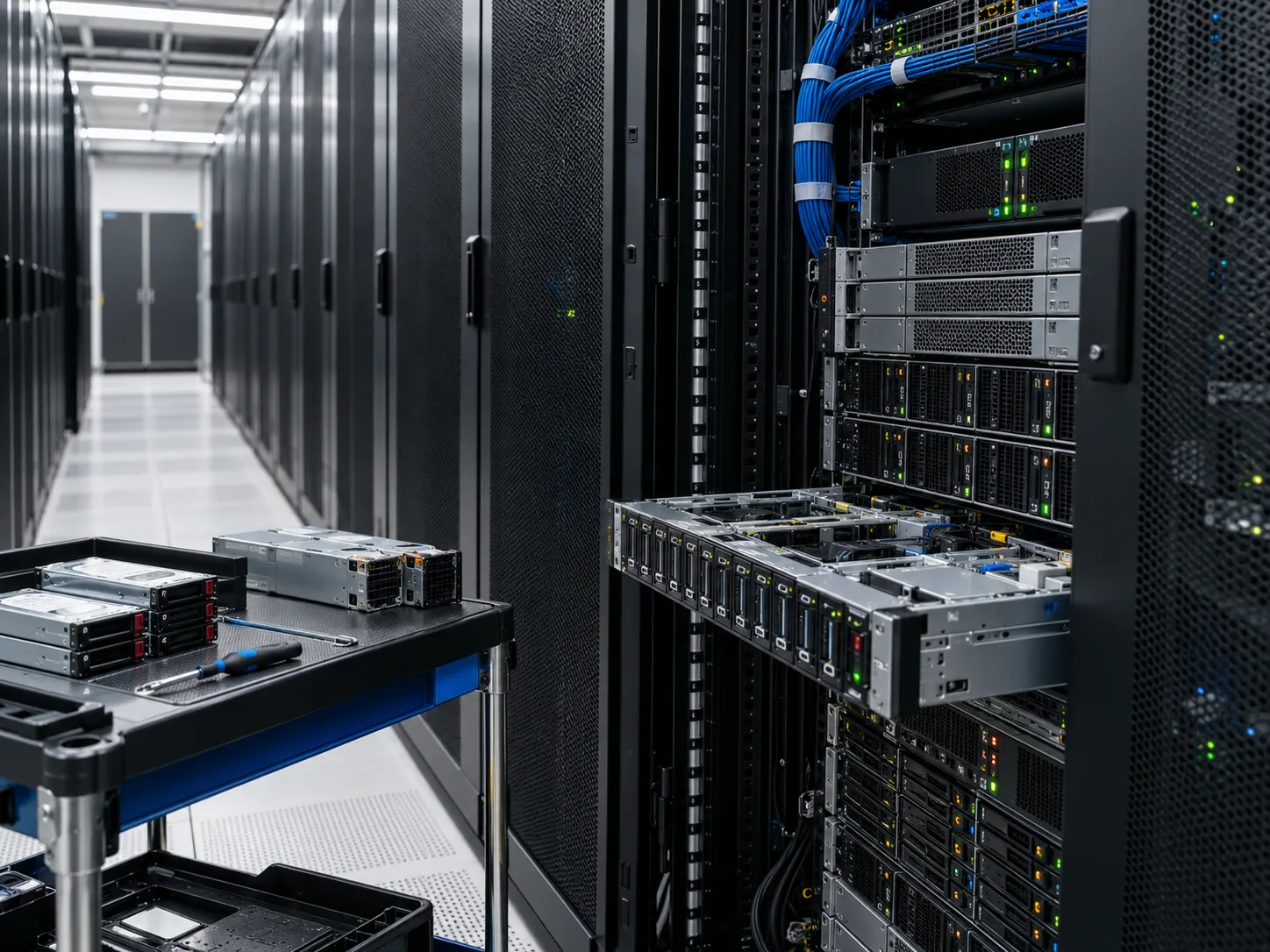
01 / The challenge
The problem is bigger than the parts list.
Parts can arrive correctly while the deployment still fails operationally. A carton may not match the rack inventory, a host may be scheduled before its workloads move, or a replacement module may carry a different part number. A fast swap without checks can add more risk than the aging component itself.
Rack labels, serials and the asset register must agree before work starts.
Hosts cannot all leave service at once; evacuation is the client’s job.
Heavy chassis, airflow, anti-static rules and nearby powered equipment.
02 / Delivery model
Five stages. Staged, not all-at-once.
Each phase is summarized below. Open any step for the underlying delivery detail.
- 01
Define the work package
Identify every host by site, rack, unit, asset and serial, with the approved part and change ticket.
Read technical detail +−
The package lists the component, approved replacement, maintenance group, tools, compatibility checks owned by the client and the change ticket. It also states what must not happen: no unapproved power disconnection, no moving unrelated cabling and no independent reconfiguration by the field engineer.
- 02
Pre-maintenance readiness
Confirm deliveries, vendor guidance, facility access and remote baselines days before the window.
Read technical detail +−
The coordinator checks component delivery and storage. The client verifies the change is supported for the exact model and configuration and defines when a live hot-swap is allowed. Remote teams prepare baselines and rollback; open questions are closed or the affected host is postponed.
- 03
Window one: a controlled trial
Replace components on a subset of hosts and pause if anything unexpected appears.
Read technical detail +−
The engineer confirms labels and serials with the remote lead and records the starting state. The remote team sets the maintenance or evacuation state first. After each host the remote lead checks hardware detection and service conditions before the next one.
- 04
Window two: repeat with evidence
Apply the lessons from window one to a device-specific list, one asset at a time.
Read technical detail +−
Revised installation order, handling notes or evidence templates carry forward. The client may confirm each asset remotely so a problem is isolated rather than discovered at the end of the night. Spares, errors and missed windows are logged as separate exceptions.
- 05
Testing & acceptance
Separate physical facts, remote test results and assumptions still to be validated.
Read technical detail +−
The engineer verifies the component is installed, secured and identifiable. The remote team confirms discovery, hardware health and service restoration against agreed criteria; facilities confirm their own items. A successful swap is never presented as proof of workload resilience or full system performance.
03 / Roles & responsibilities
Local execution. Remote control.
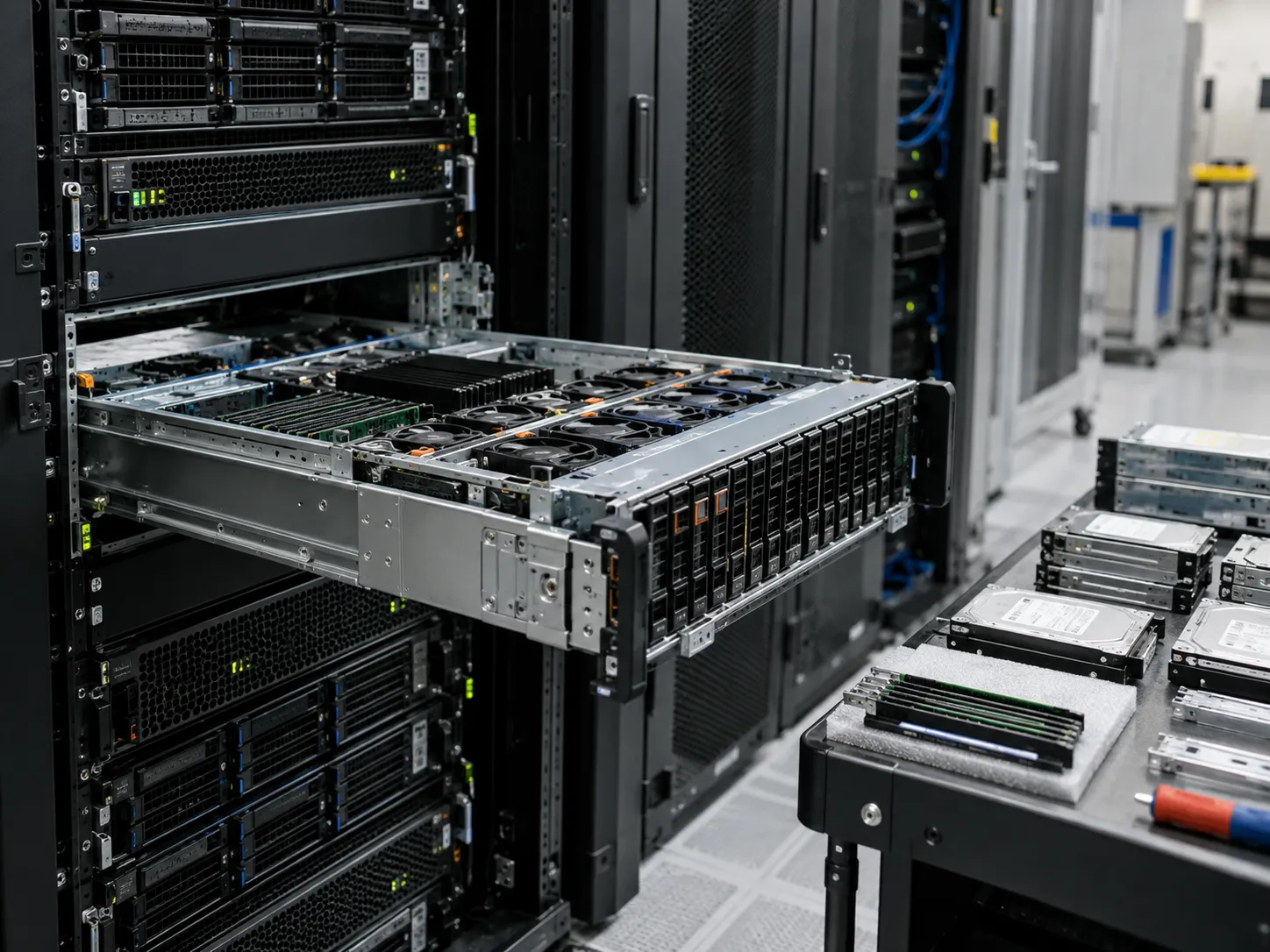
In the illustrative model, the client moves workloads and validates services, facilities own power, and the on-site partner handles identification, hardware and labeling.
Host evacuation · configuration · change approval · service validation · rollback
Rack identification · approved component installs · labeling · asset records · evidence
What if the chassis serial does not match the schedule?
The host could plausibly be identified by rack position alone, but that would be unsafe in production. The engineer stops, records the observed identifiers and asks the owner to reconcile the asset register. Work continues only after the record and the change authorization are corrected.
04 / Closeout evidence
A project record that stands up to review.
A proposed closeout would include the updated asset register, change references and component serials for each host. These are example deliverables, not measured uptime or savings.
05 / What buyers should know
Hardware modernization is safest as a controlled operation.
A disciplined field partner reduces the coordination burden around physical work—clear work packs, consistent asset handling and stage-by-stage verification—so the remote owner keeps control and its senior engineers stay on architecture and diagnostics.
What to answer before booking data center work
The exact site and cabinet, manufacturer and model, part numbers, weight and handling needs, whether power or network services are involved, the change window and remote engineer availability. Name who moves workloads, who authorizes changes, who manages spares and what completion criteria will be signed.
When storage media is involved
If the request touches drives or other storage media, agree an explicit data-handling and custody decision first. It may call for data center field support, facilities specialists, vendor engineers or a combination of all three.
Read the complete case studyFull narrative · for readers who want every detail
A data center project may be called a “hardware refresh,” yet the work usually crosses several operational boundaries: asset identification, physical safety, facility access, vendor instructions, maintenance approval, monitoring and support handover. This fictional case explores a technology partner’s planned replacement of hardware components in a shared data center environment. The point is not to claim a completed DacoreIT project. It is to show prospective infrastructure partners what should be coordinated when engineers perform physical work on systems that remain subject to remote operational control.
Scenario Snapshot
A fictional infrastructure services company supports a small private-cloud environment hosted at a regional colocation data center. Its operations team has identified eight compute hosts for planned component upgrades and a staged replacement of several redundant power supplies under manufacturer-approved procedures. The selected systems host different workloads, so the team cannot take them all out of service simultaneously. Work is planned in two maintenance windows. The client’s engineers own host evacuation, configuration and service validation; authorized data center personnel manage power and facility matters; an on-site technical partner would assist with rack identification, hardware handling, labeling and approved component installation. All quantities, timing and environment details are illustrative.
The Problem Beyond the Parts List
Components can be purchased and shipped correctly while the deployment still fails operationally. The label on a carton might not match the rack inventory, a host may be scheduled for maintenance before workloads have been moved, a replacement module may have a different part number, or a change may conflict with the facility’s access rules. Even where servers have redundant power, a technician should not assume that both feeds are independent or that a module can be removed safely while the chassis is active. The client therefore needs a process that respects separate technical, electrical, logistical and approval responsibilities. A fast swap without these checks may introduce more risk than the aging component itself.
Defining the Work Package
The project starts with an approved work list. Each host is identified by site, row, rack, rack unit, asset number and chassis serial where available. The work package specifies the component, approved replacement part, maintenance group, required tools, firmware or compatibility considerations to be checked by the client, and the change ticket under which work may occur. Dependencies include facilities permission, server maintenance state and remote engineer availability. The plan also identifies what must not happen: no unapproved power disconnection, no relocation of unrelated cabling, no independent reconfiguration by the field engineer and no claim of successful application testing based solely on an illuminated indicator.
Pre-Maintenance Readiness
Several days before the window, the coordinator confirms component delivery, inventory count and safe storage conditions. The client reviews vendor guidance and verifies that the proposed change is supported for the exact hardware model and running configuration. Where components are hot-swappable, the procedure must still specify the circumstances in which a live replacement is permitted and who authorizes it. Facilities staff confirm cabinet access and any electrical work restrictions. Remote operations teams prepare baselines for hardware health alerts, host status, virtualization capacity and backup or rollback arrangements as applicable. A readiness meeting closes open questions or explicitly postpones affected hosts instead of treating ambiguity as a technician-side problem.
Maintenance Window One: a Staged Approach
The first window is designed as a controlled trial on a subset of systems rather than an all-at-once replacement. At the rack, the on-site engineer confirms labels and serial numbers with the remote lead, checks equipment condition and records the starting state. The remote operations team establishes the agreed maintenance or evacuation state before the field activity begins. The on-site engineer installs or exchanges only the specified component following approved handling and manufacturer directions. After each host, the remote lead checks hardware detection and the agreed service-level conditions. If the first replacement reveals unexpected issues, the plan pauses before the same error can be repeated across the remainder of the estate.
Managing Physical Risks
Data center support involves constraints not always visible in a remote ticket. Technicians may encounter restricted aisles, heavy sliding chassis, elevated racks, airflow requirements, anti-static handling rules and proximity to powered distribution equipment. Work requiring licensed electrical expertise must remain with authorized personnel. Component packaging, removed hardware and tools should be kept clear of airflow paths and walkways. Each part should remain tied to an asset record so there is no uncertainty over what was removed from which chassis. These controls are operational safeguards, not optional decoration on the checklist. The correct approach depends on facility policy and the equipment manufacturer’s documentation.
Maintenance Window Two: Repeat with Evidence
Once the first group has passed its agreed acceptance checks, the second window can follow the updated procedure. The coordinator carries forward lessons such as changed installation order, revised handling instructions or a more effective evidence template. The technician works through a device-specific list, not a generic “replace eight items” instruction. The client may request a staged remote confirmation after each asset so a problem is isolated rather than discovered at the end of the night. Spare parts, unexpected errors and missed windows are recorded as discrete exceptions. In a well-designed process, the documentation makes the work repeatable for future sites without implying every infrastructure environment is identical.
Exception: a Serial-Number Mismatch
Consider a host that appears in the schedule under one serial number but bears a different chassis label at the rack. The field engineer could plausibly identify it by rack position alone, yet doing so would be unsafe in a production environment. Instead, the engineer stops, records the observed identifiers and asks the remote owner to reconcile the asset register. The owner may determine that the equipment was previously replaced, the inventory is stale, or the wrong cabinet was referenced. Only after the authoritative record and change authorization are corrected should the physical work continue. This protects neighboring assets and ensures that the final report can withstand technical and commercial review.
Testing and Acceptance
A complete acceptance sequence has multiple levels. The on-site engineer verifies that the intended component is physically installed, secured and identifiable, and that permitted visual checks are satisfactory. The remote technical team confirms device discovery, hardware health status and service restoration against predefined criteria. Where a vendor requires additional checks, they must be built into the plan. Facilities personnel confirm any changes for which they retain responsibility. The closeout pack clearly separates observed physical facts from remote test results and from assumptions yet to be validated. It should never describe a successful component swap as proof of workload resilience, disaster recovery readiness or complete system performance.
Outcome and Project Record
The fictional project ends with an updated asset register for the eight scheduled hosts, change-ticket references for each replacement, component serial records, approved evidence photographs and a list of any outstanding exceptions. The client can identify which tasks were accepted after the first window, which were completed in the second, and whether follow-up checks remain open. No measured uptime improvement, cost reduction or failure-prevention figure is invented. To turn this narrative into a verified case study, Operations would need actual maintenance records, customer authorization, approved quantities, technical acceptance outcomes and permission to disclose even anonymized environmental details.
Operational Value for an MSP or Infrastructure Partner
A remote engineering organization may design an excellent hardware plan but still depend on someone local to make it real. The value of a disciplined field partner lies in reducing the coordination burden around physical work: clear work packs, consistent asset handling, stage-by-stage verification and records that allow the remote owner to retain control. This division of labor is especially useful when a partner supports more than one facility or when its highest-skill engineers are better employed on architecture and diagnostics than travel. Field support must still be matched to genuine capability, access and equipment constraints; it should not be advertised as unrestricted intervention in any production environment.
Scoping Questions a Buyer Should Answer
Before booking a data center job, a buyer should specify the exact site and cabinet, manufacturer and model, part numbers, weight and handling requirements, whether power or network services are involved, approved change window and remote engineer availability. It should identify who will move workloads, who can authorize a change, who will manage spares, what photographs and logs can be collected, and what completion criteria the client will sign. If a request involves storage media, there should also be an explicit data-handling and custody decision. These points help determine whether the assignment calls for data center field support, facilities specialists, vendor engineers or a combination of all three.
Closing Perspective
Hardware modernization is safest when every component change is treated as a controlled operation rather than a repetitive manual task. The fictional deployment demonstrates a workflow that keeps remote design, local execution and system validation connected, with meaningful pause points when the real environment differs from the plan. It is a credible conversation starter for MSPs and integrators considering server installs, component replacement or rack-level support, but it is not evidence of an actual project delivered by DacoreIT. The next step for a prospective buyer is to share a technical work package so feasibility, responsibilities and documentation can be reviewed.