

01 / The challenge
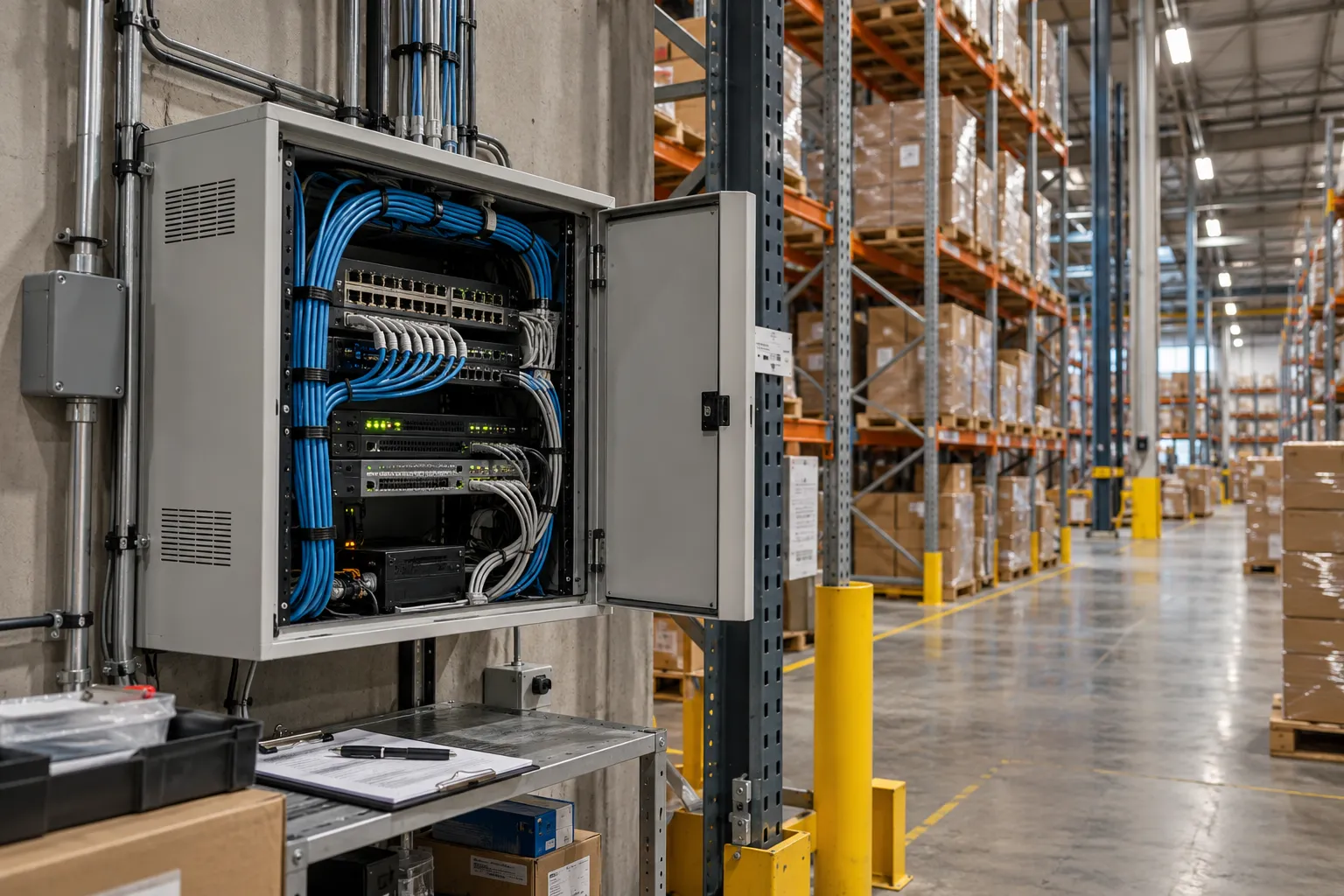
A warehouse is not an office floor.
High racks, moving forklifts, metal shelving, unknown cable routes and tight downtime windows all change who is needed and what must be approved. A playbook does not remove the risk—it exposes uncertainty early enough for the right owner to decide.
Lift equipment, high-level work and active forklift traffic.
Metal shelving and changing interference affect coverage.
Depots keep moving goods while the network changes.
02 / Delivery model
Five stages. Installed, labeled and validated.
Each phase is summarized below. Open any step for the underlying delivery detail.
- 01
Discovery & readiness
Check design assumptions, mounting drawings, cable routes, permits and controller access per site.
Read technical detail +−
A named project owner signs off scope and the contacts who may approve schedule changes, deviations and exceptions. A readiness matrix marks each task ready, blocked or awaiting clarification so blocked items stay visible instead of disappearing into email.
- 02
Roles & safety sign-off
Make explicit who authorizes access, who sets equipment rules and who owns RF design.
Read technical detail +−
Warehouse operations authorizes physical access, health-and-safety defines equipment restrictions, and the integrator owns RF design and final network acceptance. A simple RACI table and an out-of-hours contact plan cover the moments when a decision cannot be left to the person nearest the equipment.
- 03
Installation & labeling
Confirm location tags and cable continuity, install at height under authorization, label ports.
Read technical detail +−
Engineers document power and link status, work from precise asset and location references and record what they observed before and after each permitted intervention. Staged cutovers follow the integrator’s sequence; the engineer reports observations without expanding scope.
- 04
Daily delivery management
Run one shared work queue with owner, status, blockers and evidence for every task.
Read technical detail +−
A pre-start check confirms people and materials. The remote team gets concise updates at agreed milestones. At day-end the coordinator reconciles completed, deferred and exception-flagged work; anything needing another visit has a named reason and owner.
- 05
Remote acceptance
The integrator confirms adoption, VLAN and SSID policy, coverage tests and roaming.
Read technical detail +−
Physical observation is kept apart from technical validation: an engineer can confirm an access point is connected, but cannot attest that every application or security control works. Criteria are agreed before the first visit and each owner signs off what it actually tested.
03 / Roles & responsibilities
The integrator designs the network. The field team builds it safely.
In the illustrative model, responsibility is split between depot operations, safety staff, the integrator and the local installation team—and no party claims authority outside its contract.
RF design · controller configuration · cutover approval · coverage and roaming acceptance
Cable continuity · authorized high-level installs · port labels · power and link records · photos
What if a new storage rack blocks a planned access point?
Instead of letting the technician improvise a new position, the site safety contact and the wireless designer review an alternate location. The task is paused, the difference is documented and the authorized owner amends the work package—no fictional “completed” status to keep a dashboard green.
04 / Closeout evidence
A clear line between installed and validated.
A proposed closeout would separate physical installation, remote configuration and observed coverage. These are example deliverables, not claimed service levels.
05 / What buyers should know
Repeatable means the same questions every time.
No two depots are identical. A repeatable service model asks the same questions about scope, authority, safety, acceptance and documentation at every site—which makes cross-site review and invoicing easier to defend.
What to bring to a network support conversation
A clear business objective, the current inventory or system context, locations and access rules, the expected change window and a named decision-maker. Ask which work is in scope, what specialist subcontractors would do, how unexpected conditions are escalated and what evidence comes at completion.
Why mounting is not the same as coverage
An installed access point proves the hardware is in place. Coverage, roaming and application behavior can only be accepted by the team that owns the RF design and controller—so the report shows both, separately.
Read the complete case studyFull narrative · for readers who want every detail
The example concerns a fictional logistics operator modernizing wireless coverage at four warehouse depots. The customer profile is deliberately anonymous and entirely invented. A network integrator responsible for design and configuration who needs coordinated local access and installation assistance. The working scope comprises an illustrative 46 access points, designated network switches, mounting materials and a remote-managed wireless controller. The exact numbers serve to help the reader imagine project complexity; none reflects a verified DacoreIT deployment. The case explains why a carefully structured operating model could be useful, what would need to be established before execution, and what evidence would separate a credible closeout from an informal claim. It is intended for partner decision-makers who must align people, technical work, local operations and client expectations before committing to delivery.
Business Need and Commercial Context
The central customer request is to install the approved access point layout and validate practical connectivity without suggesting that mounting devices alone proves radio performance. This may sound like a single operational requirement, but it has direct commercial implications. An MSP or integrator needs to protect its end-customer relationship, prevent ambiguous ownership, and avoid sending engineers into situations where the work cannot be completed as specified. Projects that lack an authoritative work list often consume time during site visits because the coordinator, the on-site person and the remote specialist each understand the task differently. In this scenario the prospective field partner would therefore be evaluated not just on technician availability, but on the quality of its pre-work coordination and acceptance records.
Operating Constraints
Several predictable factors make the assignment harder than a checklist suggests: high racks, moving forklifts, metal shelving, warehouse downtime constraints, unknown cabling routes, and changes to interference patterns. Each constraint changes the type of personnel, approvals or contingency planning required. It would be misleading to promise that a standard playbook removes all technical risk; rather, the playbook exposes uncertainty early enough for responsible owners to make a decision. The statement of work should identify activities inside the support provider's control, activities retained by the customer or remote team, and activities requiring specialist contractors. Any assumption about geography, access privileges, response times or subcontracting capacity must be validated for the actual engagement.
Initial Discovery and Readiness
Before dispatch or implementation, the team compiles predictive design and survey assumptions, approved mounting drawings, cable routes, site safety permits, lift-equipment responsibilities and remote controller access. Each element is checked against the current work request rather than a historical record. One named project owner signs off the scope and designates contacts with authority to approve schedule changes, technical deviations and exceptions. A readiness matrix categorizes each task as ready, blocked or awaiting clarification. Blocked tasks stay visible instead of disappearing into a shared email thread. This discipline gives project leaders a realistic operating picture and reduces the temptation to count an appointment as progress before the site, materials and required permissions are actually prepared.
Clear Roles and Responsibility
Responsibility must be explicit: warehouse operations authorizes physical access, health-and-safety personnel define equipment restrictions, and the integrator owns RF design and final network acceptance. These roles may be carried by different organizations in the same engagement, and no party should imply it has authority over systems or people outside its contract. A simple RACI-style table can show who requests work, approves changes, performs physical tasks, runs logical validation and accepts final handover. A separate contact plan covers escalation during nonstandard hours or site closures. The arrangement becomes particularly important when a field technician encounters an unexpected condition and needs a decision that cannot safely be delegated to the person standing closest to the equipment.
Implementation Method
In the illustrative delivery approach, engineers confirm location tags and cable continuity, coordinate authorized high-level installations, label ports, document power and link status, and work with the integrator on staged cutovers. Each stage has an entry condition and a completion condition. The sequence should be adapted to manufacturer instructions, relevant local rules and the client's change or safety policy, not treated as a universal technical method. Work instructions should use precise asset and location references instead of ambiguous phrases such as “the unit on the left.” Engineers should record what they observed before and after permitted interventions. Where remote specialists control configuration or approval, the on-site engineer reports their observations and follows the authorized sequence without independently expanding the scope.
Day-To-Day Delivery Management
The coordinator operates a shared work queue that records the current task owner, site or device identifier, appointment time, status, blockers and evidence required at closure. A short pre-start check confirms people and materials are ready. During execution, the remote team receives concise updates at agreed milestones rather than a constant stream of unstructured messages. At day-end, the coordinator reconciles completed, deferred and exception-flagged work against the original plan. Any activity requiring another visit has a named reason and owner. This prevents work from being marked as finished simply because an engineer left the site, while preserving an audit trail for the MSP's account team.
Quality Control and Acceptance
The acceptance process distinguishes physical observation from technical or business validation. For this scenario, the remote network team confirms adoption, VLAN and SSID policy, coverage test plans, roaming behavior and relevant device connectivity at defined test points. That distinction matters because an engineer can sometimes confirm that a component is connected, yet cannot responsibly attest that every dependent application or security control is functioning. Approval criteria should be agreed before the first visit, with the relevant owner signing off what they actually tested. A work package that requires photographs, serial verification and remote acceptance cannot be closed with only a technician's narrative statement. Conversely, unnecessary evidence collection should be avoided where it would expose confidential information or create new security risk.
How the Team Handles an Exception
Suppose a planned access point position is blocked by a newly installed storage rack; the site safety contact and wireless designer review an alternate location rather than allowing a technician to improvise. A mature response begins by pausing the affected task, documenting the observed difference and confirming who can approve the next step. The exception is classified by operational impact and dependencies, rather than quietly buried in a general comment. The authorized owner can choose to amend the work package, order missing parts, allocate a specialist or postpone the action. The engineer should never create a fictional “completed” outcome to keep a reporting dashboard green. That transparency may produce a temporary delay, but it enables reliable forecasting and protects the parties from disagreements about whether agreed work was actually delivered.
Documented Project Evidence
The closeout package would include as-installed device register, approved mounting deviations, labeled switch ports, survey or acceptance observations, and open coverage exceptions. Each record is tied to a real task or asset reference and stored under the customer's approved information-handling process. Information that should not be disclosed publicly—such as employee names, credentials, site security plans or sensitive infrastructure labels—must be excluded from marketing material. Evidence should show the limits of what was verified as well as what was completed. When a milestone is not fully accepted, the report should specify why, what remains to be done, who owns that action and what would permit closure. A consistent record makes cross-site review and invoicing more defensible.
Outcome
In this invented project, the site refresh has a defensible line between physical installations, remote network configuration and independently observed operational coverage. The result is a coherent operational scenario, not an assertion that DacoreIT has achieved specific service levels, incident reductions or savings. A genuine client story would require source evidence before displaying numerical improvements. Appropriate sources might include approved ticket exports, acceptance forms, measured baseline comparisons, installation logs or asset reports, depending on the service. When such evidence is absent, the page should continue to explain how the process works and which deliverables a customer could request. This transparent framing is more useful than a dramatic but unsupported claim of flawless results.
What a Prospective Customer Should Ask
A buyer considering this service should bring a clear business objective, a current inventory or system context, the locations and access rules involved, an expected change window, and a named decision-maker. It should ask the service provider which work is in scope, which work will be undertaken by specialist subcontractors, what tools or permissions are required, how unforeseen conditions are escalated, and which evidence will be supplied on completion. The buyer should also clarify whether a single project or continuing operational coverage is needed. These answers make it easier to estimate cost, select qualified resources and avoid assumptions that lead to repeat attendance or unclear responsibilities.
Reusability and Next Steps
This example is intentionally specific enough to support a meaningful proposal conversation, while leaving the commercial and technical details open for validation. A repeatable service model does not mean every site or customer has identical needs; it means that the same questions about scope, authority, safety, acceptance and documentation are asked every time. The story may be adapted into a shorter landing-page summary, a LinkedIn educational post, an account-based outreach asset and a sales discussion checklist, provided it remains visibly marked as fictional. The next practical step is for the interested partner to share a genuine work package so DacoreIT can review feasibility with its Operations team.